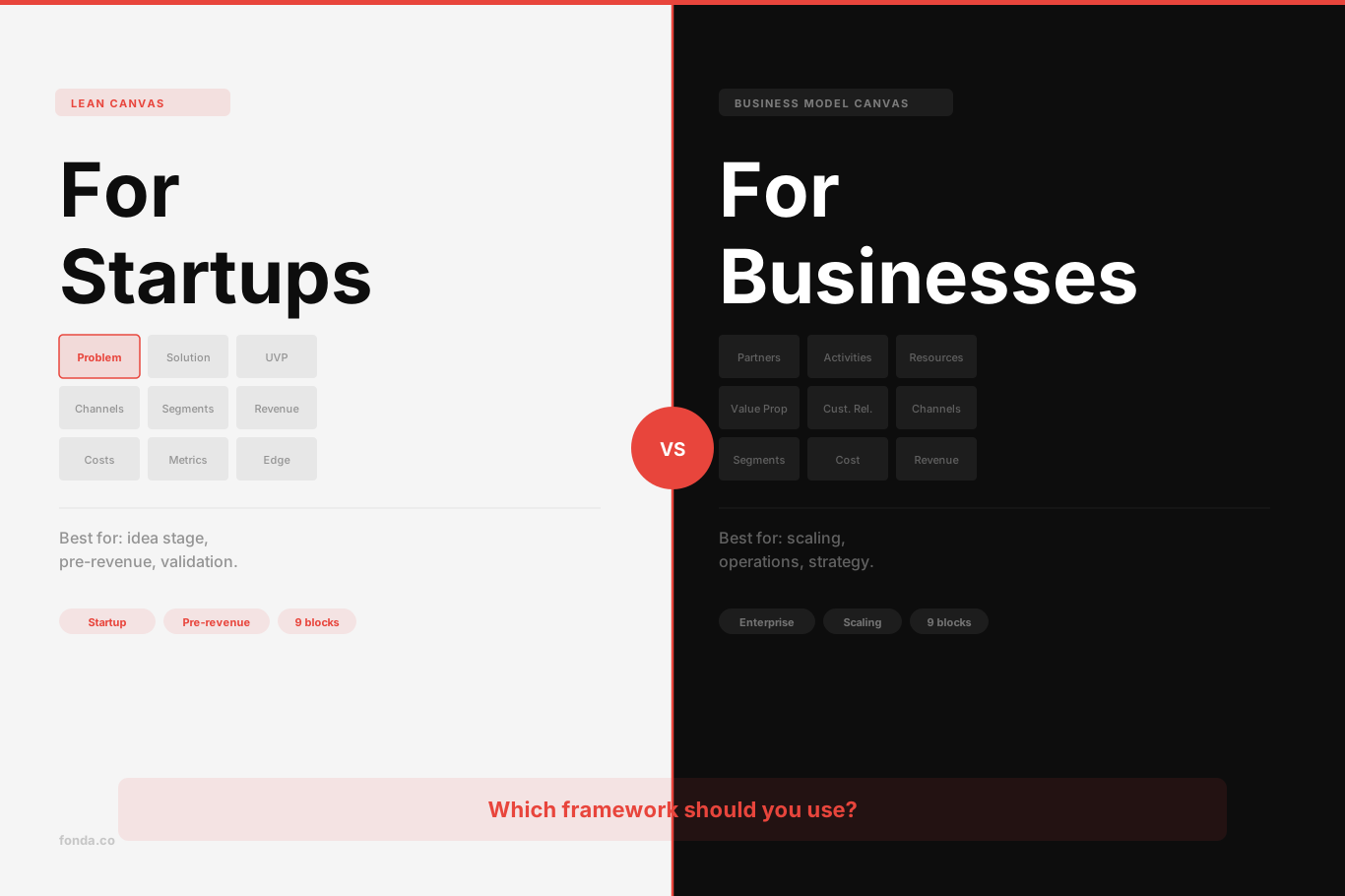
Lean Canvas vs Business Model Canvas: Which One Should You Use?
Both frameworks map a business on one page. But they were built for different stages and answer different questions. Here is how to pick the right one.
Quick Answer
Use Lean Canvas if you're pre-product. Use Business Model Canvas if you're scaling.
- Lean Canvas — designed for startups. Focuses on Problem, Solution, and Unfair Advantage. Best for pre-product, pre-revenue founders.
- Business Model Canvas — designed for existing businesses. Better for Key Partners, Key Activities, Key Resources — blocks that matter after you have a working model.
Where each framework comes from
The Business Model Canvas was created by Alexander Osterwalder and Yves Pigneur, published in their 2010 book Business Model Generation. It was designed to help companies — not startups — understand and redesign their existing business models. It assumes you already have customers, operations, and partners.
The Lean Canvas was adapted by Ash Maurya in 2010, published in Running Lean. Maurya replaced four blocks from the Business Model Canvas (Key Partners, Key Activities, Key Resources, Customer Relationships) with four startup-specific blocks: Problem, Solution, Key Metrics, and Unfair Advantage. The goal was a framework that works before you have any of the things the original Canvas assumes.
Block-by-block comparison
| Block | Lean Canvas | Business Model Canvas |
|---|---|---|
| Problem | Top 3 problems you're solving | N/A — not a block |
| Solution | Your solution to the 3 problems | Value Propositions (broader) |
| Key Metrics | The one or two numbers that matter | Key Activities (what you do) |
| Unfair Advantage | What cannot be easily copied | N/A — not a block |
| Customer Segments | Who has the problem (early adopters) | Customer Segments (broader) |
| Channels | How you reach customer segments | Channels (same) |
| Revenue Streams | How you make money | Revenue Streams (same) |
| Cost Structure | Your main costs | Cost Structure (same) |
| Key Resources / Partners | N/A | Key Resources + Key Partners |
Blue rows = blocks where Lean Canvas is more specific to startup stage.
When to use each
Use Lean Canvas when…
- ✓ You have an idea but no product yet
- ✓ You're still testing your core assumptions
- ✓ You need to identify your riskiest hypotheses
- ✓ You want to communicate the business to early advisors
- ✓ You have fewer than 10 paying customers
Use Business Model Canvas when…
- ✓ You have a working, proven business model
- ✓ You're mapping operations and supplier relationships
- ✓ You're presenting to a corporate strategy audience
- ✓ You're redesigning an existing business unit
- ✓ Key Partners and Key Activities are core to your model
Free tool
Generate your Lean Canvas in 60 seconds
Describe your idea and get all nine Lean Canvas blocks filled in for you. Free, no account required.
Frequently asked questions
What is the difference between Lean Canvas and Business Model Canvas?+
The Lean Canvas was adapted from the Business Model Canvas specifically for startups. It replaces Key Resources, Key Activities, Key Partners, and Customer Relationships with Problem, Solution, Key Metrics, and Unfair Advantage — blocks that are more relevant to early-stage companies that don't yet have stable operations or established partnerships.
Which should a first-time founder use?+
For a first-time founder, the Lean Canvas is almost always the right choice. It forces you to define the problem before the solution, name your unfair advantage, and identify the one or two metrics that will tell you if the business is working. These are exactly the questions a first-time founder needs to answer before building anything.
Can I use both?+
Yes — in sequence. Use the Lean Canvas in the early validation phase when you're still testing your assumptions. Once you have a validated business model and are transitioning to scaling, the Business Model Canvas becomes more relevant because Key Resources, Key Activities, and Key Partners start to matter operationally.
How do I fill out a Lean Canvas?+
Start with the Problem block — name the top three problems your target customer faces. Then define your Customer Segments: who specifically experiences these problems, and which subset will be your early adopters. Then fill in Solution, UVP, Channels, Revenue Streams, Cost Structure, Key Metrics, and Unfair Advantage — in that order. The Lean Canvas Generator at fonda.co/tools/lean-canvas does this in 60 seconds.
Related reading
How to Write a Business Plan for a Startup
After the canvas — write the full plan
10 Startup Idea Validation Mistakes
Validate before committing to any canvas
First-Time Founder Checklist
The Lean Canvas is phase 3 — here's the full picture
How to Calculate TAM SAM SOM
Market sizing for the business model canvas