How to Start a Business with AI in 2026 (Step-by-Step Guide)
For the first time, one person with AI can do what used to take a founding team: research a market, validate an idea, write a plan, build a product, and land the first customers. This is the step-by-step guide to doing it — the seven stages, the tools for each, and the mistakes that quietly kill AI-first businesses before they start.
Quick Answer
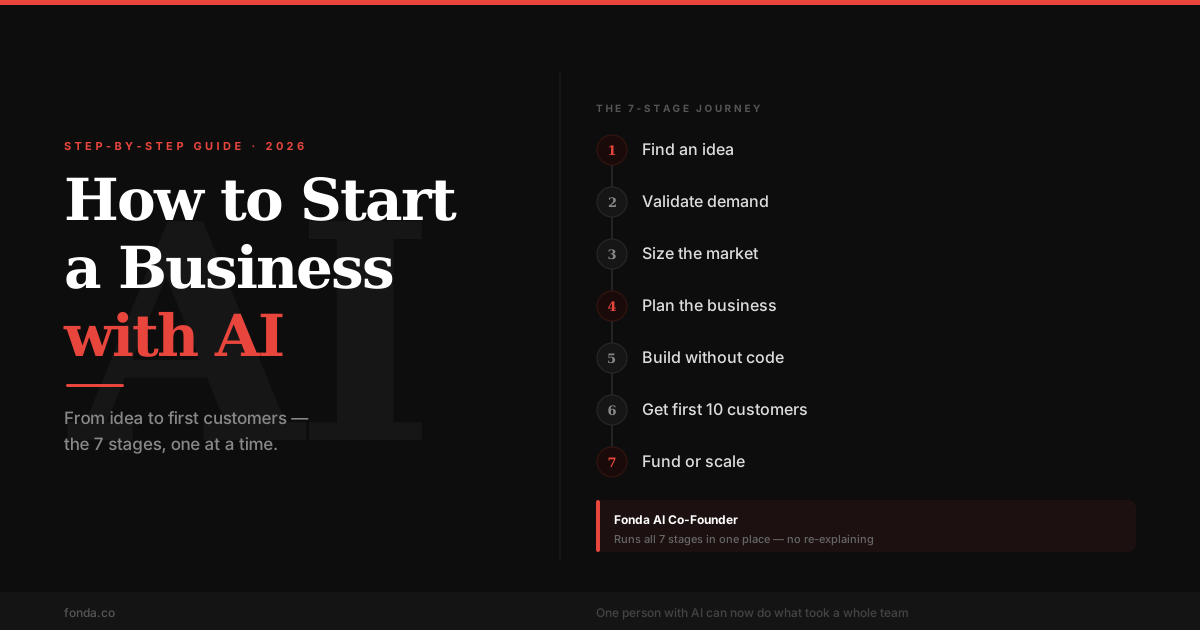
To start a business with AI in 2026, work through seven stages:
- 1. Find an idea — generate ideas matched to you and pressure-test the weak points
- 2. Validate demand — confirm real people will pay before you build
- 3. Size the market — a defensible bottoms-up TAM, SAM, SOM
- 4. Plan the business — a real business plan and model from a paragraph
- 5. Build without code — a landing page or one-feature MVP
- 6. Get your first 10 customers — go where they already are
- 7. Fund or scale — a pitch deck and the loop that never stops
The barrier to starting a business used to be resources — money, a team, technical skills, industry connections. AI has removed most of that barrier. In 2026, the research an analyst charged $5,000 for is a prompt away. The landing page a designer billed two weeks for is generated in an afternoon. The first version of the product that needed a developer is built by describing it in plain English.
But cheaper and faster does not mean automatic. AI makes it trivial to produce a business plan, a product, and a pitch — which means the number of half-baked, unvalidated ideas being launched has exploded. The founders who win aren't the ones who move fastest; they're the ones who move through the right stages in the right order. Here's that order.
What AI Changes — And What It Doesn't
It helps to be precise about what AI actually does for a new founder, because the hype obscures it. AI does not have taste, judgement, or customer relationships. It will not know that your pricing is wrong, that your target customer is the wrong one, or that the market moved last month. Those are your job, and they always will be.
What AI does is collapse the production cost of everything between decisions. Market research, competitor breakdowns, a first-draft business plan, a landing page, a first version of the product, outreach copy, a pitch deck — the drafting and grunt work that used to require money and a team is now fast and nearly free. You spend your time deciding and talking to customers; AI fills in the space between.
The one mistake to avoid up front
Don't run your whole startup through a single general chatbot. It forgets everything between sessions, so you re-explain your business every time, and it optimizes for a pleasing answer rather than a correct one. The point of an personal co-founder is that it holds your context across every stage and pushes you toward the next decision — which is exactly what a chatbot can't do.
The 7 Steps to Start a Business with AI
Each stage has one job and the AI tools that do it best. Do them in order — the most common failure is jumping to step five (building) before doing steps one and two (idea and validation).
Find an idea AI can help you pressure-test
Start with a problem, not a tool. The best AI businesses solve a specific, painful problem for a specific person — not "an AI app for productivity." Use AI to generate ideas matched to your own skills, budget, and interests, then immediately pressure-test each one: who is the exact first customer, what do they pay for today, and why would they switch? A general chatbot will happily talk you into any idea. A tool built for this will tell you where it's weak.
Validate demand before you build anything
This is the step beginners skip and later regret. Before writing code, confirm that real people have the problem and would pay to solve it. Use AI to draft interview questions and a short validation survey, identify where your customers already gather online (subreddits, forums, communities), and analyze the responses for genuine signal versus politeness. The goal is to hear "where do I sign up" from strangers — not "nice idea" from friends.
Size the market so you know it's worth it
You don't need a McKinsey report — you need a defensible, bottoms-up estimate of TAM, SAM, and SOM so you know the opportunity is big enough to matter and small enough to enter. AI can produce this in minutes with clear assumptions you can actually defend, instead of the "our market is $500 billion" hand-wave that makes investors wince. A tight, believable SOM beats a giant top-down number every time.
Turn the idea into a business plan and model
Once the idea survives validation, get it on paper. AI can draft a real business plan — market analysis, customer segments, go-to-market, a Lean Canvas, and a first-pass financial model — from a paragraph describing your idea. This isn't busywork: writing it forces the decisions you've been avoiding (pricing, channels, unit economics) into the open. Treat the AI draft as a first version to sharpen, not a final document.
Build a landing page or MVP without code
Now build the smallest thing that tests whether people will act. Often that's a landing page with a clear offer and a signup or pre-order button — no product required yet. When you do need a working product, AI no-code builders like Lovable and Bolt.new generate functional web apps from a prompt, and tools like Bubble and Glide handle more complex logic. Build one core feature. Resist everything else.
Get your first 10 customers
A product with zero customers is a hobby. Your first ten come from going where your customers already are — not from ads. Use AI to write outreach, tailor a pitch to each community, and draft the content that pulls people to your landing page. Do things that don't scale: DM people, join the conversations, offer to solve the problem manually for your first users. Ten paying (or paying-intent) customers is the milestone that turns an idea into a business.
Raise money or grow — then keep the loop running
With traction, you decide: bootstrap and grow on revenue, or raise. If you raise, AI can build an investor-ready pitch deck from your live plan and help you find the right investors for your stage. Either way, the loop never stops — you keep validating, shipping, and talking to customers. The founders who win in 2026 aren't the ones with the fanciest AI; they're the ones who use it to move through this loop faster than everyone else.
The AI Tool for Each Stage
You don't need thirty AI tools. You need the right one for the job in front of you. Here's the whole journey mapped to what each stage actually requires.
| Stage | The job to be done | Tool type |
|---|---|---|
| Find an idea | Generate ideas matched to you; pressure-test the weak points | AI idea generator / AI co-founder |
| Validate demand | Draft surveys, research communities, read the signal | Survey + research tools |
| Size the market | Bottoms-up TAM, SAM, SOM with defensible assumptions | TAM SAM SOM calculator |
| Plan the business | Business plan, Lean Canvas, financial model | AI business plan generator |
| Build the product | Landing page or functional MVP, no code | Lovable, Bolt.new, Bubble |
| Get customers | Outreach copy, content, community pitches | AI writing + cold email |
| Fund or scale | Pitch deck, investor matching | AI pitch deck generator |
Fonda runs all seven stages in one place, keeping your business context across every step — so you never re-explain your idea and never wonder what to do next. That's the difference between a stack of disconnected tools and an personal co-founder.
4 Mistakes That Kill AI-First Businesses
The failure patterns are predictable, and every one of them is avoidable if you know it's coming.
Notice the through-line: every mistake is a version of letting the ease of AI substitute for the judgement of a founder. The tools got faster; the discipline of building something people actually want did not change at all.
How Long It Takes and What It Costs
If you stay focused, the whole path from idea to a live product with real customer conversations takes about two to four weeks. Week one is idea, validation, and plan. Week two is a landing page or MVP. Weeks three and four are your first ten customers. None of these stages is slow because of the tools — they're slow when founders stall on decisions or quietly skip validation.
The cost is similarly low. You can validate an idea, size the market, and stand up a landing page for under $50 a month using free and low-cost AI tools. A no-code MVP adds roughly $20–50. The expensive parts of starting a business — research, design, first-draft code, copywriting — are precisely the parts AI now does for almost nothing. Your real investment is time and attention, not capital.
Start the journey with your personal co-founder
Fonda takes you through all seven stages — idea, validation, plan, build, customers, and funding — with a personal co-founder that remembers every decision. It's the fastest way to go from "I want to start something" to a real, validated business.
See how Fonda works →Frequently Asked Questions
Can you really start a business with AI in 2026?+
Yes — and it's now the default for solo founders. AI won't run your business for you, but it collapses the parts that used to require a team or an agency: market research, competitor analysis, a business plan, a landing page, a first version of the product, and early marketing copy. What used to take three months and several thousand dollars now takes a few weeks and close to nothing. The founder still makes the decisions and talks to customers; AI does the drafting, research, and grunt work in between.
How much does it cost to start a business with AI?+
Less than most people expect. You can validate an idea, build a landing page, and get your first customer conversations for under $50/month using free and low-cost AI tools. A no-code MVP adds roughly $20–50/month. The main cost is your time, not your money — which is exactly why AI-first businesses are so accessible in 2026. The expensive parts of starting up (research, design, first-draft code, copywriting) are the parts AI now does cheaply.
What is the best AI tool to start a business?+
It depends on the stage. For finding and pressure-testing an idea, use a dedicated AI co-founder or idea tool rather than a general chatbot, because it keeps context across steps. For a first product, use no-code AI builders like Lovable or Bolt.new. For copy and content, use Claude or ChatGPT. The mistake most beginners make is trying to run the whole journey through one general chatbot, which forgets everything between sessions and gives generic advice.
Do I need technical skills to start an AI business?+
No. In 2026 you can build a functional product without writing code, and you can do all your research and planning in plain English. Technical skills help if you're building deep AI infrastructure, but the vast majority of AI-assisted businesses — services, tools, content, marketplaces, niche SaaS — can be started by a non-technical founder using no-code and AI tools.
How long does it take to start a business with AI?+
You can go from idea to a live product with paying-intent signups in about two to four weeks if you stay focused. Week one is idea, validation, and business plan. Week two is a landing page or MVP. Weeks three and four are getting your first ten customers. The thing that slows founders down is not the building — it's indecision and scope creep, both of which a structured process (or a personal co-founder that enforces one) helps prevent.
Related reading
How to Validate a Startup Idea with AI
The framework for step two, in depth
How to Build an MVP Without Writing Code
The no-code build stack for step five
How to Find Your First 10 Customers
The channels that work without a budget
AI Co-Founder: What It Actually Is in 2026
Why a co-founder beats a chatbot for this journey