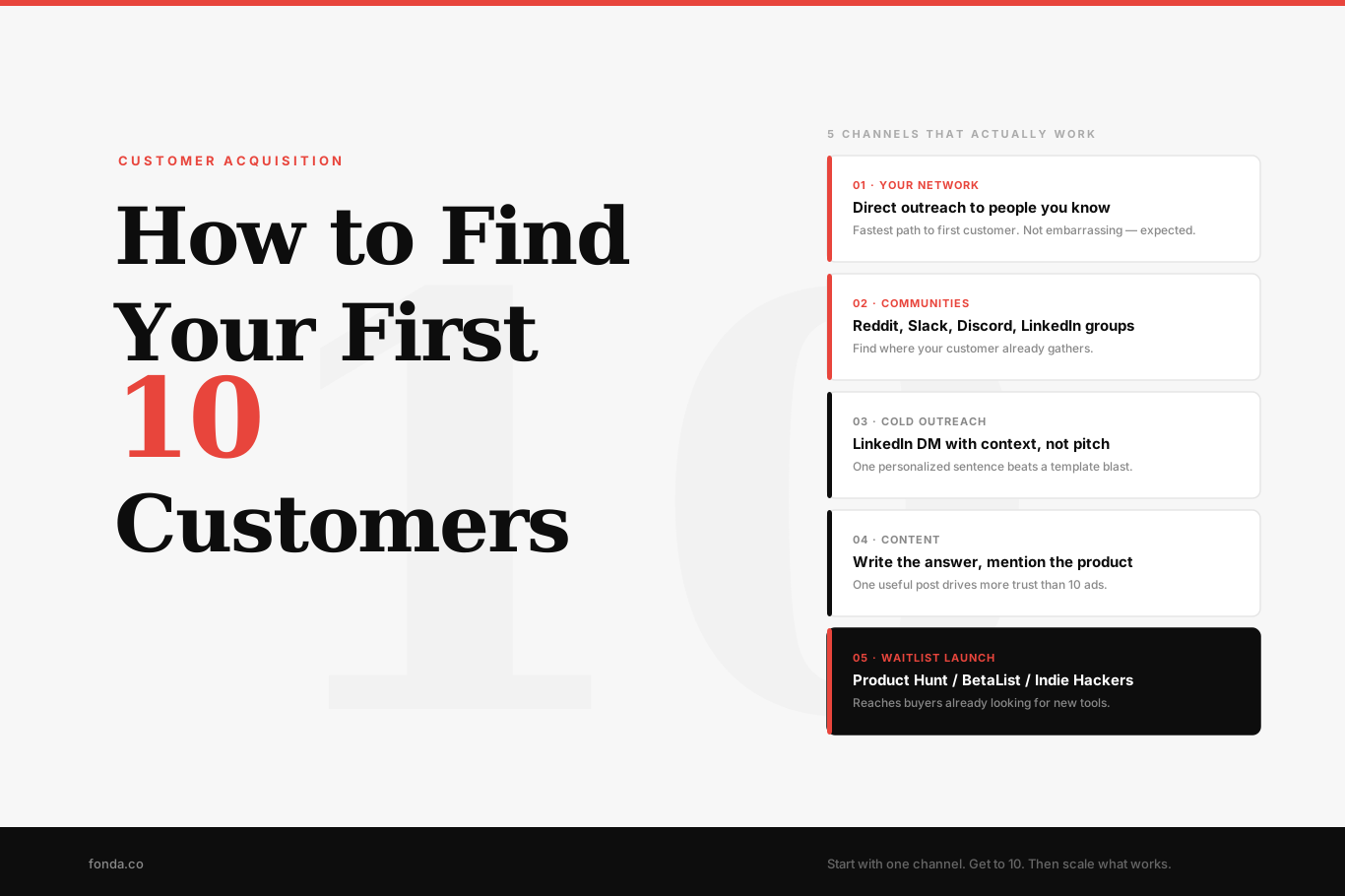
How to Find Your First 10 Customers (Without Ads or an Audience)
Your first 10 customers don't come from marketing. They come from manual outreach, specific communities, and relentless follow-through. Here are the five channels that actually work — and exactly how to use each one.
Quick Answer
Five channels that work before you have a budget or an audience:
- 1. Your existing network — fastest path, most underused
- 2. Online communities — Reddit, Slack, Discord, LinkedIn groups
- 3. Cold outreach — personalized, specific, 20 people at a time
- 4. Content — one useful answer drives more trust than 10 ads
- 5. Launch platforms — Product Hunt, Show HN, Indie Hackers
Getting to 10 customers is a different problem than getting to 1,000. At 1,000 customers, you need scalable systems: paid acquisition, SEO, a sales team. At 10 customers, you need none of that. You need to find 10 specific people with a specific problem and convince them, one at a time, that your product solves it.
That means doing things that don't scale. Call people. Join communities. Write personal messages. This is not a phase to rush through — it's where you learn what your customers actually care about, which is information no amount of ad spend can buy.
Why 10 is the milestone
1 customer proves nothing.
They might be a friend. They might be an exception. One customer is not a signal.
3–5 customers proves interest.
Enough to keep going. Not enough to understand the pattern.
10 customers proves a repeatable motion.
By the 10th customer, you know which channel works, which message converts, and which customer type is most likely to buy. That is the foundation of a business.
Your existing network
FastestThe single fastest path to your first customer is someone you already know, or someone they know. This feels uncomfortable to most founders because it mixes personal and professional relationships. That discomfort is misplaced. You are offering to solve a real problem — asking someone to try your product is not imposing on them.
How to use it
- 1.Write a list of 50 people: former colleagues, managers, clients, classmates, and friends who work in your target industry
- 2.For each person, write one sentence about why your product is specifically relevant to them
- 3.Send a personal message — not a newsletter-style broadcast — that references something specific about them
- 4.Ask for a 20-minute call, not for them to buy. The sale happens after they understand the problem you solve
- 5.After the call, follow up within 24 hours with one clear next step
Message template
"Hey [Name], I've been working on [product] — a [one-line description] for [customer type]. I think it could help with [specific problem they have]. Would you be open to a 20-minute call this week? I'd love your honest take on whether this actually solves something you deal with."
Don't send the same message to everyone. Personalization is what gets replies. One personalized message to 10 people beats a generic message to 100.
Online communities
ScalableYour customers already gather somewhere online — a subreddit, a Slack group, a Discord server, a LinkedIn group, an industry forum. These communities are concentrations of people who have the exact problem you're solving. The approach is not to post an ad. It's to become a useful member first, then mention the product when it's genuinely relevant.
How to use it
- 1.Find 3–5 communities where your target customer is active: Reddit, LinkedIn Groups, Slack communities (Indie Hackers, On Deck, etc.), Discord, or niche forums
- 2.Spend two weeks reading before posting — understand what questions come up repeatedly
- 3.Write one genuinely helpful post that addresses a common question, with no mention of your product
- 4.Once you have credibility, reply to threads where your product is directly relevant: 'I built something for exactly this — happy to share if it would help'
- 5.Message people who engage with your replies directly — they've already signaled interest
Community reply template
"This is exactly the problem I've been working on. I built [product] to handle [specific issue you described] — it [core mechanism in one sentence]. Happy to give you early access if you want to try it, no strings attached."
Don't post promotional content in communities before you've contributed. Moderators will remove it and your credibility goes with it.
Cold outreach
High-effort, high-returnCold outreach works when it's specific and personal. The failure mode is sending 200 identical LinkedIn DMs that read like ad copy. The success mode is identifying 20 specific people who are very likely to have the problem you solve, researching each one for two minutes, and writing a message that references something real about them. Response rates jump from under 2% to 15–25% with genuine personalization.
How to use it
- 1.Define a very narrow target: not 'small business owners' but 'UK-based freelance consultants with 1–5 employees who bill by the hour'
- 2.Use LinkedIn Sales Navigator (or the free search) to find 20 people who match exactly
- 3.Read each person's recent posts or activity before writing
- 4.Write a message under 80 words with three components: why you're reaching out to them specifically, one sentence on the problem, one clear ask
- 5.Follow up once after 5 days if no reply. If still nothing, move on — don't pester
Cold DM template
"Hi [Name] — I saw your post about [specific thing they wrote]. I've been building [product] for [exact customer type like them]. It [does one specific thing] — which I think might help with [problem you noticed]. Would a 15-minute call this week make sense? Happy to share what I've learned either way."
Track your reply rate per batch of 20. If it's below 10%, rewrite the message before sending more. Volume doesn't fix a broken message.
Content that solves the problem
CompoundingContent works for early-stage customer acquisition when it is specific, genuinely useful, and appears where your customers are searching. Not a brand blog. A piece of content that answers the exact question your customer is Googling or asking on Reddit — and then mentions that you built a product to solve that problem. One useful piece of content pulls in customers for months.
How to use it
- 1.Find the top 3 questions your target customer asks online (use Reddit, Quora, Google 'People Also Ask', and LinkedIn search)
- 2.Write a detailed answer — longer and more useful than anything currently ranking
- 3.Publish it where your customers already look: a blog post (for Google search), a Reddit thread answer, a LinkedIn article, or a newsletter
- 4.Include one natural mention of your product: 'I built [product] to handle exactly this — here's how it works'
- 5.Respond personally to every comment or engagement in the first 48 hours
CTA at end of content
"If this problem sounds familiar, I built [product] to handle [specific thing]. It's free to try — [link]. Happy to answer questions in the comments."
Content takes time to compound. Don't write one post and give up after a week. Publish one useful piece per week for 8 weeks before drawing conclusions.
Launch platforms
One-time burstProduct Hunt, Hacker News (Show HN), Indie Hackers, and BetaList reach an audience of people who are actively looking for new products. A well-timed launch on these platforms can generate 200–500 sign-ups in 48 hours. But this only works if the product is polished enough to stand up to scrutiny, and if you can respond personally to every comment within the first few hours.
How to use it
- 1.Build a waitlist before launching — target 50–100 people who've already expressed interest and will upvote on day one
- 2.Write a launch post that leads with the problem, not the product: 'I got frustrated with [problem]. I built [product] to solve it.'
- 3.Post on Product Hunt at 12:01 AM PST (when the voting day starts) to maximize 24-hour window
- 4.Write a Show HN post for Hacker News if your product has technical depth — the audience responds to technical founders
- 5.Post in relevant Indie Hackers threads and subreddits on the same day to amplify
Product Hunt tagline formula
"[Product] — [what it does in under 8 words] for [specific customer type]" Example: "Fonda — AI co-founder for first-time startup founders"
A launch is a single spike, not a strategy. Use it to get your first 100 sign-ups. Then figure out which of those users converted to paying customers and what channel they came from.
The 10-customer tracker
For each customer, record how they found you, what they paid, and what made them buy. After 10, patterns become visible.
| # | Channel | What convinced them | Price paid |
|---|---|---|---|
| 01 | — | — | — |
| 02 | — | — | — |
| 03 | — | — | — |
| 04 | — | — | — |
| 05 | — | — | — |
| 06 | — | — | — |
| 07 | — | — | — |
| 08 | — | — | — |
| 09 | — | — | — |
| 10 | — | — | — |
After 10 rows: the channel with the most conversions is your primary channel for the next 90 days.
What comes after 10
Identify the one channel that produced the most of them. Double down on it exclusively for 30 days.
Raise the price. If the conversion rate holds, you're under-charging. Test a 20–40% increase.
Start testing a second channel. Don't split focus earlier — learn one motion completely first.
Now run small paid experiments. You know what converts organically; use that to write ad copy that matches.
Built for this exact stage
Fonda helps you get from idea to first customer
Validate before you build. Write the pitch. Map the GTM. Your AI co-founder guides you through every step — so you find customers who pay, not just users who sign up.
Frequently asked questions
How long does it take to get 10 paying customers?+
For most B2B startups, 4–12 weeks from first launch if you're actively working all the channels above. B2C depends heavily on price point — low-price consumer products can convert faster but get lower commitment. The key variable is how much time you personally spend on sales every day. Most first-time founders underinvest in sales. Getting to 10 customers should be your only job for the first 60 days.
Should I use paid ads to find early customers?+
Not until you have product-market fit. Paid ads amplify what's already working — they don't create it. If your conversion rate is 0.5% organically, ads will give you a 0.5% conversion rate at much higher cost. Use manual channels first: personal outreach, communities, and content. Once you understand what message converts and which customer converts, then test small ad budgets to scale what's working.
What if I don't know anyone in my target market?+
Start with communities. Reddit, LinkedIn Groups, Slack groups, and Discord servers let you find and talk to your exact target customer even if you don't know anyone personally. Spend two weeks in the communities where your customer hangs out before posting anything. Ask genuine questions. Offer help. After you've contributed, mention your product when it's relevant. You'll have warmer conversations than cold outreach, faster.
How do I know if my first 10 customers are representative?+
They probably aren't — early customers tend to be the most motivated subset of your target market, not the average. This is fine. Early adopters are the ones who will give you the most detailed feedback and tolerate the most rough edges. The risk is assuming that what they love is what the mainstream market will love. After 10 customers, do a pattern analysis: what do they have in common? How did they find you? What made them buy? That defines who to target next.
What's the difference between a user and a customer?+
A user has signed up. A customer has paid. For most early-stage startups, these numbers are very different — and only paying customers tell you whether you have a real business. Free trials, waitlists, and signups are useful leading indicators, but the question to ask every day is: how many paying customers do we have, and how did each one find us?
Related reading
10 Startup Idea Validation Mistakes
Make sure you're selling to the right people before scaling
First-Time Founder Checklist
The full journey from idea to first customer
How to Write a Business Plan for a Startup
Document the GTM strategy you're building
How to Turn a Side Hustle into a Startup
When consistent customers signal it's time to go full-time