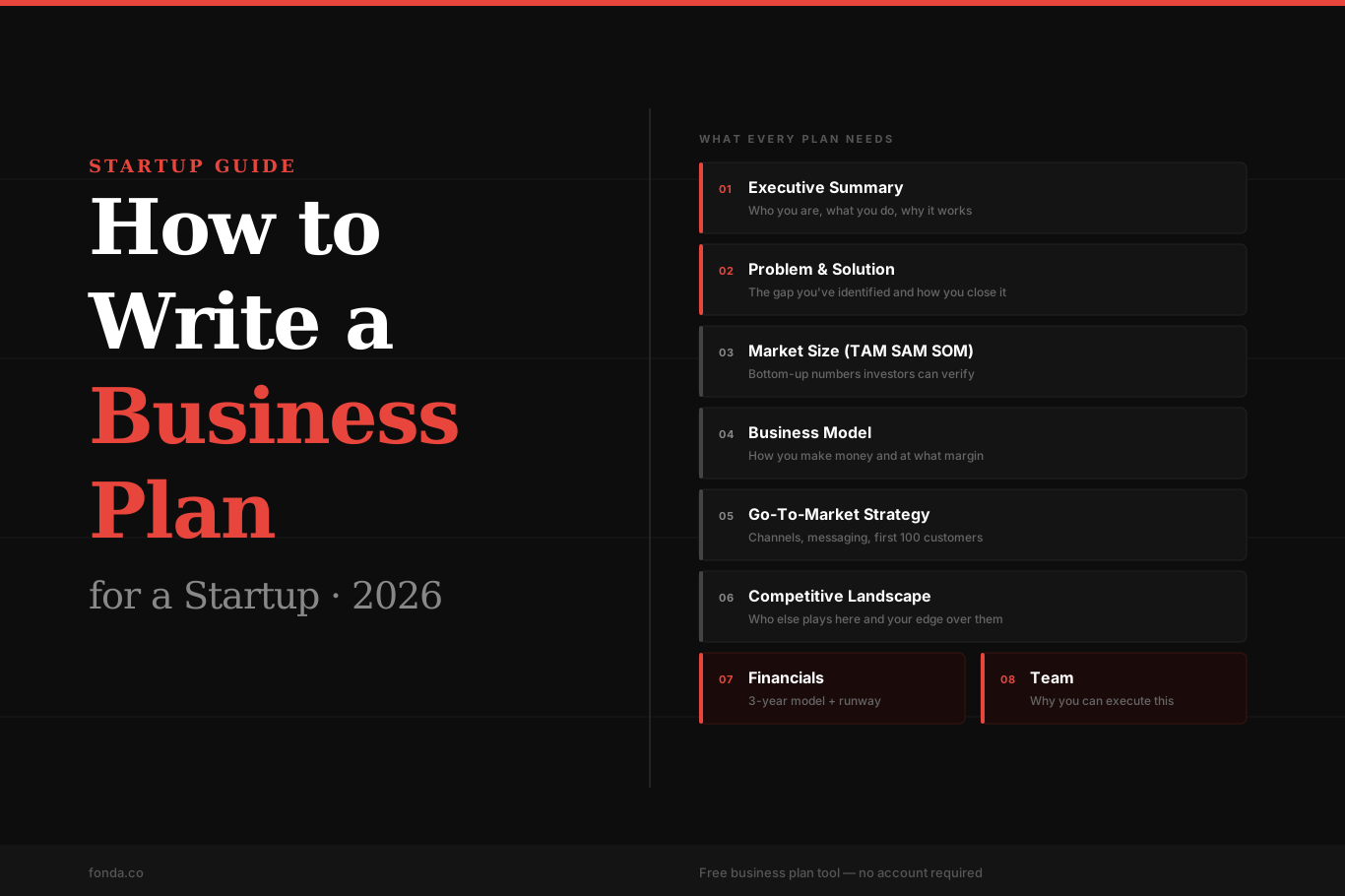
How to Write a Business Plan for a Startup (2026 Guide)
Most startup business plans are either too long, too vague, or built for the wrong reader. This guide covers the eight sections every plan needs — what belongs in each one, common mistakes, and how to make investors keep reading.
Quick Answer
A startup business plan has eight sections:
- 1. Executive Summary — write this last; it summarizes everything else
- 2. Problem & Solution — prove the pain before pitching the fix
- 3. Market Size — bottom-up TAM SAM SOM with sources
- 4. Business Model — who pays, how much, and the unit economics
- 5. Go-To-Market — how you get the first 100 customers, specifically
- 6. Competition — every alternative, and your clear edge over each
- 7. Financials — assumptions first, projections second
- 8. Team — why you, why this market, why now
A business plan is not a document you write for investors. It is a document you write for yourself — to find out whether your idea holds together when every assumption is written down and stress-tested. Investors read it to verify what you already know.
That's why the founders who write great business plans are usually the ones who already have deep conviction about their market. The writing process built it.
Before you write
Three questions to answer before opening a document:
Who is reading this?
A seed investor has different questions than an accelerator program director or a bank. Know the reader before you set the tone.
What decision does this plan support?
Raising a pre-seed round? Applying to YC? Recruiting a co-founder? The plan should be scoped to the decision it's helping make.
What's the strongest thing you can prove right now?
Lead with it. Traction beats projections. A signed customer beats a market research report.
Write last
Executive Summary
The executive summary is the only section investors read before deciding whether to keep going. It is not an introduction — it is a self-contained pitch. In two pages or less, it answers: what is the company, who is it for, what problem does it solve, how does it make money, how big is the opportunity, and why is this team the one to win it. Every word earns its place.
What to include
- Company name, one-line description, and founding date
- The problem and your specific solution
- Target customer — one sentence, as narrow as possible
- Current traction: users, revenue, growth rate, or waitlist
- Business model in one sentence
- Funding ask (if applicable) and what it funds
Write this section last. It should summarize the plan you've already written — not forecast a plan you haven't thought through yet.
Most important section
Problem & Solution
This is where most first-time founders lose investors. The problem section is not a place to describe a market trend or a personal frustration. It is a proof that a specific group of people has a painful, frequent, and expensive problem that they are currently working around in an unsatisfying way. The solution section follows directly: here is what we built, and here is why it solves the problem better than everything they've already tried.
What to include
- Who has the problem — describe the customer in one sentence
- What the problem costs them: time, money, or both
- What they do today to work around it (current alternatives)
- Why current alternatives fall short
- Your solution and the core mechanism that makes it work
- Proof it works: a quote, a case study, or an early result
The best problem statements quote a real customer. 'Our users told us...' carries more weight than 'research shows...'
Show your math
Market Size (TAM SAM SOM)
Investors don't trust TAM numbers pulled from market research reports. They trust bottom-up calculations you've built yourself — because those show you understand your customer, your pricing, and your distribution. Total Addressable Market (TAM) is the full universe; Serviceable Addressable Market (SAM) is what you can realistically reach; Serviceable Obtainable Market (SOM) is what you'll capture in years one through three.
What to include
- TAM: total revenue available if you had 100% market share
- SAM: the TAM segment your product and channel can reach
- SOM: your projected capture of SAM in 3 years (with rationale)
- Bottom-up formula: (number of customers) × (annual price) = market
- Source every number — no 'a report says the market is $4B'
- Link SOM to your go-to-market strategy so it's defensible
SOM that looks achievable (2–5% of SAM) is more credible than SOM that looks ambitious (20%+ of SAM). Investors have seen the full range.
Keep it simple
Business Model
The business model section answers: how do you make money, who pays, how much, and how often. Startups fail to explain their business model clearly because they confuse revenue model with pricing. Revenue model is the structure (subscription, usage-based, marketplace take-rate, one-time sale). Pricing is the number. Both belong here, along with your gross margin so the reader understands how the unit economics work.
What to include
- Revenue model: subscription, transactional, freemium, marketplace, etc.
- Pricing: exact numbers with the rationale behind them
- Who pays: is it the end user, a business, or a third party?
- Gross margin: revenue minus direct cost of delivering the product
- Unit economics: customer acquisition cost vs lifetime value
- Comparison to competitors' pricing to show you've thought it through
If your business model requires a complex explanation, simplify the model — not the explanation. Investors fund businesses they understand.
Specifics beat vision
Go-To-Market Strategy
The go-to-market section is where most plans turn vague. 'We'll use social media and SEO and partnerships' is not a strategy. A real GTM section names the specific channel you're using first, how much a customer costs to acquire through that channel, and how you'll scale when you've proved it works. Focus on the first 100 customers. What are their names? Where do you find them? What do you say?
What to include
- Primary channel: where your first 100 customers come from
- Channel validation: have you already acquired customers this way?
- Customer acquisition cost in the primary channel
- Sales process: how long from first contact to payment
- Retention and referral: how do customers come back and bring others
- Scale plan: what happens in month 6, month 12 if the channel works
Name your first 10 customers specifically. 'We'll target SMEs in the logistics sector' is not a GTM. 'We have conversations with these 10 companies' is.
Don't say 'no competition'
Competitive Landscape
Saying you have no competition is the fastest way to lose credibility with an investor. Every market has competition — if there isn't a direct competitor, that's a signal the market doesn't exist or something else is blocking it. The competitive section identifies who else plays in your space, how customers solve the problem today, and where you are specifically differentiated. A positioning matrix helps if it reflects reality.
What to include
- Direct competitors: companies solving the same problem
- Indirect competitors: alternatives customers use today (including spreadsheets, agencies, doing nothing)
- Your differentiation: not a list of features — one clear edge
- Why that edge is defensible (timing, data, distribution, network effect)
- What incumbents can't copy and why
- One-line positioning: 'For [customer] who [problem], we [solution], unlike [alternative] which [weakness]'
The strongest competitive slide shows you understand the competitive landscape better than the investor does. Name every relevant player before they ask.
Model the assumptions, not just the numbers
Financial Projections
No one believes a first-time founder's three-year revenue projection. That's not what the financials section is for. It's for showing you understand the levers: what drives revenue, what drives cost, where the unit economics break even, and how much runway each funding scenario buys. The projections demonstrate business logic, not clairvoyance. Show a base case and a conservative case. Investors fund the team — the model shows whether you can think clearly under pressure.
What to include
- Revenue model with monthly projections for year 1, annual for years 2–3
- Key assumptions stated explicitly: conversion rate, churn, average revenue per user
- Cost structure: what the major expense categories are
- Burn rate and runway at the current spend rate
- Break-even point: when does the business become cash-flow positive
- Funding ask tied to specific milestones (not 'to grow the team')
Show two scenarios: base and conservative. Never show optimistic only. The investor will build the conservative case in their head anyway — give them yours.
Why you, why now
Team
Early-stage investors back teams more than ideas. The team section is not a LinkedIn summary — it is an argument for why this specific group of people is better positioned to win this specific market than anyone else who might try. It answers: what relevant experience do you have, what have you built before, and what is the unfair advantage each person brings. Three strong sentences per founder beat a paragraph of generic bio.
What to include
- Founder names and roles
- Each founder's most relevant prior experience in two sentences
- Specific evidence of execution: companies built, products shipped, customers acquired
- Gaps in the team and the plan to fill them (shows self-awareness)
- Advisors if relevant — name and why they matter to this business specifically
- Why this team, this market, right now
If you've sold to customers in this market before, led a team before, or built a product in this category before — say so explicitly in the first sentence.
Business plan vs pitch deck: which do you need?
| Situation | What you need | Why |
|---|---|---|
| Cold investor outreach | 1-page executive summary + deck | Investors read the deck first. The full plan comes after interest. |
| Accelerator application | Full business plan | Applications ask the same questions as a plan — write it once. |
| Co-founder recruitment | Deck + financial model | Show vision first; serious candidates ask for the model. |
| Bank loan / SBA | Full business plan with financials | Banks need the full document. No deck substitute. |
| Strategic clarity (you) | Full business plan | Writing forces you to reconcile assumptions that don't add up. |
The 5 most common business plan mistakes
Writing the executive summary first
Fix: Write it last. It summarizes a plan you haven't finished thinking through yet.
Projecting hockey-stick growth with no channel logic
Fix: Every revenue number should trace back to a specific customer acquisition channel and a conversion rate you've tested.
Saying 'our only competition is doing nothing'
Fix: Describe every alternative in detail. Then explain why each one falls short. This shows market understanding, not market denial.
Generic team bios
Fix: Each founder gets one sentence of relevant experience and one sentence of evidence. Cut the rest.
Making it too long
Fix: If a section doesn't answer a question the reader has, cut it. Plans over 30 pages are rarely read fully.
Free — no account required
Generate your business plan with AI
Describe your idea and get the first sections of a real business plan — market analysis, competitive overview, and opening strategy — in under two minutes.
Frequently asked questions
How long should a startup business plan be?+
For a funding pitch, 15–25 pages is the standard for a full business plan document. For an investor pitch deck, 10–14 slides. The length should match the stage: a pre-seed plan can be shorter than a Series A plan because there is less to prove. Every section should be as short as it can be while answering the reader's question completely.
Do I need a business plan if I'm not raising money?+
Yes — a business plan is more useful for the founder than for any investor. Writing it forces you to reconcile your assumptions: if your market size doesn't support your revenue projection, or your customer acquisition cost is higher than the lifetime value, you find that in the plan before you find it in the market. Think of it as stress-testing your thinking before you bet time and money on it.
What's the difference between a business plan and a pitch deck?+
A business plan is a full document — 15–25 pages — that explains the business in complete prose and analysis. A pitch deck is a visual summary of the same material, usually 10–14 slides, designed to be presented in a meeting. Both cover the same ground; the plan is the source and the deck is the extract. Write the plan first, then use it to build the deck.
What do investors look for in a business plan?+
Investors look for three things: a real problem (is the pain urgent and expensive?), a credible solution (does the mechanism of value creation make sense?), and a team that can execute (have these people built or sold anything before?). Traction — users, revenue, growth rate — is the most credible signal. A business plan that shows all three and backs every claim with evidence will get read.
Can AI write a business plan for me?+
AI can generate the structure, draft sections, fill in market data, and produce a starting point faster than you can write from scratch. But no AI tool knows your customers, your competitive insight, or what makes your specific advantage defensible. Use AI to accelerate the draft — especially market sizing and financial modeling — and then rewrite every section in your own voice with your own data. The plan should sound like you, not like a template.
Related reading
How to Calculate TAM SAM SOM
The market sizing section of your plan, fully explained
Lean Canvas vs Business Model Canvas
Which one-page framework belongs in your plan
How to Find Your First 10 Customers
The go-to-market section made concrete
10 Startup Idea Validation Mistakes
Validate before you write the plan