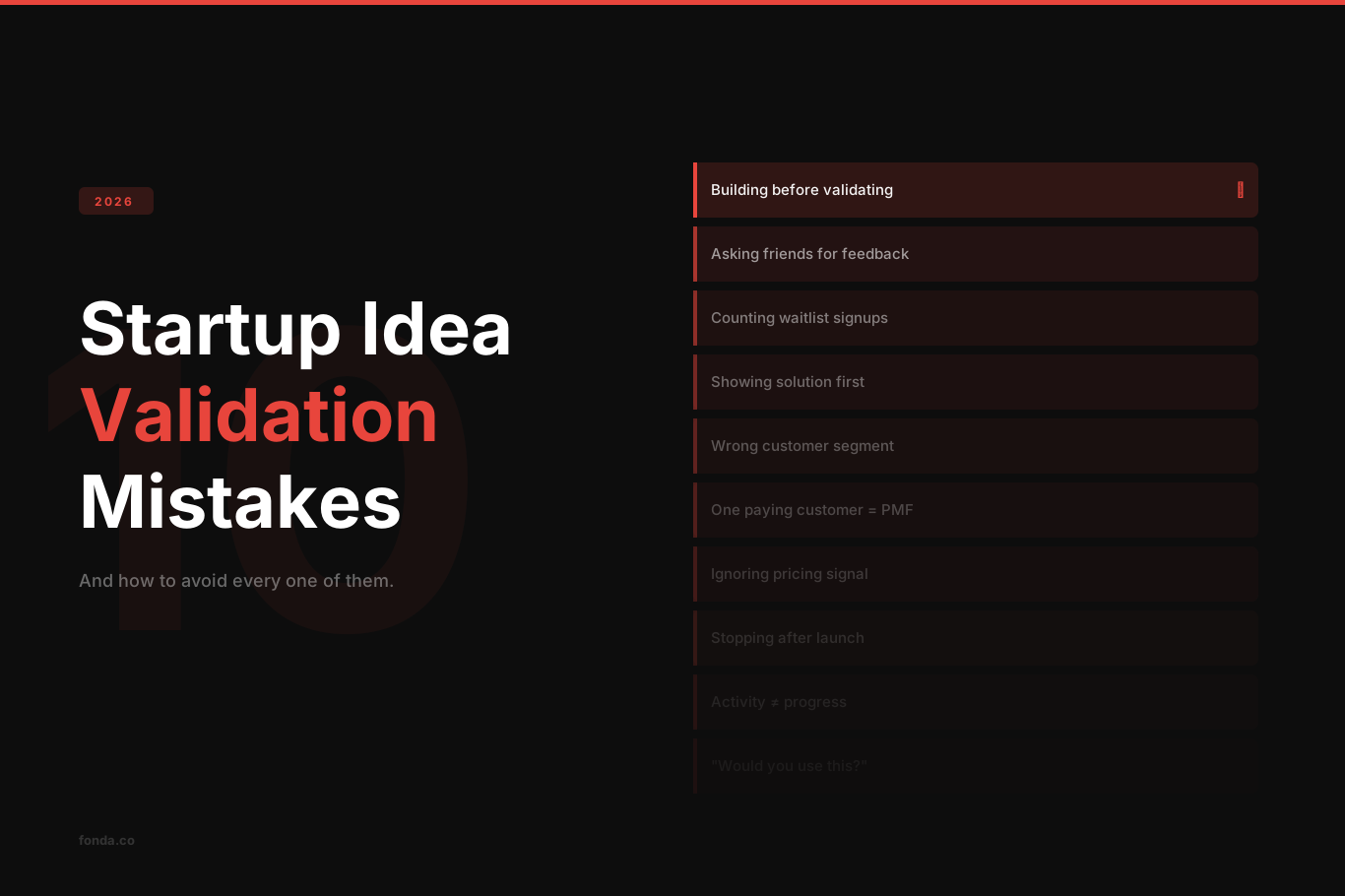
10 Startup Idea Validation Mistakes (And How to Avoid Them)
Most founders think they're validating their startup idea. They're not. Here are the 10 patterns that produce fake confidence — and what real validation looks like instead.
Quick Answer
The 10 startup validation mistakes:
- 1. Asking if people like the idea (not if they have the problem)
- 2. Interviewing people who want to be helpful
- 3. Building before validating
- 4. Counting waitlist signups as validation
- 5. Showing the solution before understanding the problem
- 6. Validating with the wrong customer segment
- 7. Treating one paying customer as product-market fit
- 8. Confusing activity (interviews, events) with progress
- 9. Ignoring the pricing signal
- 10. Stopping validation after launch
Validation is the most important and most misunderstood step in building a startup. Founders do it wrong in surprisingly consistent ways — and the cost is months of wasted building, followed by a launch that goes nowhere.
These are the ten patterns we see most often. Each one produces the feeling of validation without the substance of it.
Asking if people like the idea instead of whether they have the problem
"Would you use an app that did X?" is not validation. People say yes to hypothetical products because it costs them nothing. The only meaningful question is: "How are you currently dealing with this problem?" and "What have you tried?" Real validation is finding people who have actively spent money or time trying to solve the problem you're addressing. Enthusiasm for your idea means nothing. Evidence of a real problem means everything.
Fix
Replace "would you use" questions with "tell me about the last time this problem cost you money or time." If the problem never surfaces in real conversation, it may not be real enough to build a business on.
Real signal
Real demand signal: Someone describes the problem unprompted and mentions what they've already tried.
Interviewing people who want to be helpful
Friends, family, former colleagues, and warm LinkedIn connections are the worst validation sources. They want to support you. They filter their honest feedback through their relationship with you. They say "this sounds great!" when they mean "I'd never use this." Founders consistently over-rate positive signals from people who care about them and under-rate negative signals from strangers — who have no incentive to be polite.
Fix
Talk to strangers. Find real potential customers in online communities, LinkedIn groups, subreddits, or industry events. If you can't get 10 strangers to give you 20 minutes to discuss the problem, that's a signal.
Real signal
Real demand signal: A stranger you've never met agrees to a conversation and says "yes, I deal with this every month."
Building the product before validating the problem
Six months of engineering before a single customer conversation. This is the single most common cause of startup failure. The founder was so confident in the idea that they treated validation as a formality. Then the market disagreed. Building first is expensive twice: once in time and money, and again when you have to un-build or rebuild based on what customers actually needed. Every month of building before validation is a month of risk accumulation.
Fix
Set a validation threshold before you write a single line of code. "I will not build until I have 5 signed letters of intent or 10 customers on a waitlist who've given me their credit card details." Then hold yourself to it.
Real signal
Real demand signal: Someone pays in advance for something that doesn't exist yet.
Counting waitlist signups as validation
A waitlist is a leading indicator, not proof of demand. People sign up for things because signing up costs them nothing. They give an email, not a credit card. Until the moment someone has to pay, you don't know whether you have demand or curiosity. Founders have built entire products based on 10,000-person waitlists only to launch to 2% conversion and a business that doesn't work. Waitlists tell you the problem resonates as a headline. They don't tell you whether people will pay.
Fix
Add a payment step to your waitlist. Even $1 is infinitely more predictive than a free signup. If people won't pre-pay a nominal amount, the demand signal is much weaker than it appears.
Real signal
Real demand signal: Paying customers, letters of intent, or contracts signed before the product exists.
Showing the solution before understanding the problem
You've built a prototype. You show it in the first five minutes of every customer call. Now every conversation is about your specific execution, not the underlying problem. Customers critique the UI, suggest features, and tell you about edge cases — all of which is noise until you've confirmed the core problem is real. When you show the solution first, you anchor the conversation and lose the most valuable data: what customers actually do today without you.
Fix
Follow the Mom Test (Rob Fitzpatrick): never mention your solution in the first half of an interview. Ask about the problem, the frequency, the workarounds, the cost. Only show your solution once you have a clear picture of the context.
Real signal
Real demand signal: The customer describes your solution's core mechanism as something they've wished existed, before you mention it.
Validating with the wrong segment
You talk to 10 people who match a broad description ("marketing professionals") and get positive feedback. You start building for that segment. But your product only really works for one specific type of marketing professional — freelance B2B content marketers at $200k+ annual personal revenue who have two or more clients simultaneously. Everyone else finds it less compelling. The broad segment validated enthusiasm for the general idea; the narrow segment validates the specific business.
Fix
Write the tightest possible customer profile before you begin interviews: job title, company size, specific problem, geography, and buying authority. If 7 of 10 people in that narrow profile validate the problem, you have a real signal.
Real signal
Real demand signal: You could write a 100-word description of your ideal customer and identify 50 of them on LinkedIn in an hour.
Treating one paying customer as proof of product-market fit
Your first paying customer is proof that one person thinks your product is worth paying for. That's it. It's not proof of a market. Every startup has at least one early adopter who will pay for almost anything because they're desperate enough. The signal becomes real when customers who don't know each other independently arrive at the same conclusion — that your product is the best solution to a problem they care about.
Fix
Set a higher bar: 10 paying customers in the same narrow segment, with a clear retention signal (they keep paying and refer others), is the minimum meaningful proof of product-market fit.
Real signal
Real demand signal: Your 5th paying customer found you through a referral from one of your first 4.
Confusing activity with progress
You've had 40 interviews. You've built a prototype. You've been to three industry events. You have a landing page. You have a Notion document full of insights. But you have zero paying customers and no commitment from anyone to pay. Activity feels like progress because it's exhausting and visible. Real progress is a narrower hypothesis, a deeper understanding of a specific customer, or money changing hands. Everything else is movement without momentum.
Fix
Measure validation by outcomes, not activities: paying customers, signed LOIs, retained users, referrals. Ask weekly: "What have I learned that changed my hypothesis?" If the answer is nothing, the activity isn't generating real signal.
Real signal
Real demand signal: Your hypothesis has changed at least twice based on what customers told you — and the new version is more specific and credible.
Ignoring the pricing signal
Most founders validate whether the problem is real but forget to validate whether anyone will pay a price that makes the business work. A customer who validates the problem and agrees to pay $10/month is a different signal than a customer who validates the problem and agrees to pay $500/month. The willingness-to-pay conversation is where most founders discover that their unit economics are broken: the customer exists, the problem is real, but no one will pay enough to run a business on it.
Fix
In every validation conversation, ask directly: "If we built this, what would you pay for it monthly?" Then propose a price 2–3× what they say. If they walk away, you have a pricing ceiling. If they accept, you know your floor.
Real signal
Real demand signal: Customers give you a number higher than your cost of acquisition, and some pay it on the spot.
Stopping validation after launch
The most dangerous stage of validation is the period just after launch. Early traction can mask fundamental problems. Your first 100 customers might be enthusiastic early adopters who don't represent your target market at all. Retention rates look fine for the first 30 days, then collapse at 60–90. Validation is not a phase — it's a continuous process. Many founders stop asking the hard questions once the product is live because the act of shipping makes them feel validated.
Fix
Build validation into your product permanently: monthly NPS surveys, cancellation interviews, activation cohort analysis, and regular customer calls (at least 2 per month, indefinitely). The best founders never stop talking to customers — they just change what they're asking.
Real signal
Real demand signal: Customers refer others without being asked, and they can clearly articulate why in their own words.
Tools that help you validate properly
Use these at each stage of the validation sequence.
Roast My Idea
Get an feasibility score across 6 dimensions before you begin customer interviews.
Startup Idea Generator
Get a tailored idea with founder-market fit built in — then validate it.
Lean Canvas Generator
Map your business model after validation to confirm the unit economics work.
TAM SAM SOM Calculator
Size the market to confirm there are enough potential customers to build a real business.
Guided validation
Fonda runs the validation process with you, step by step
Your co-founder designs your customer discovery plan, helps you find real potential buyers, and gives a scored go / refine / pivot verdict.
Frequently asked questions
What is startup idea validation?+
Startup idea validation is the process of confirming that a problem is real, that your target customer has it, and that they would pay for a solution — before you invest significant time or money building anything. Good validation replaces assumptions with evidence. The goal is to find out as quickly and cheaply as possible whether your startup hypothesis is worth pursuing.
How many customer interviews do I need to validate a startup idea?+
The minimum meaningful signal comes from 10 conversations with strangers who match your precise customer description. Fewer than 10 is anecdote, not data. After 10–20 conversations, clear patterns should emerge. If patterns are still unclear at 20, your customer definition is too broad — narrow it and run another batch. The interviews should focus on the problem, not your solution.
What counts as real validation for a startup idea?+
Real validation requires three things: (1) Real people with the problem — not friends, family, or warm connections. (2) Evidence of the problem costing time or money — not just agreement that the problem exists. (3) Money or commitment — a pre-order, a letter of intent, or a signed contract. Waitlist signups, enthusiastic conversations, and LinkedIn likes are not validation.
How long should startup idea validation take?+
Four weeks is the target for initial validation. Week 1: Define the hypothesis and customer profile. Week 2: Find and schedule 10 customer conversations. Week 3: Conduct interviews and compile findings. Week 4: Update the hypothesis, attempt a pre-sale or letter of intent. If you can't complete this in 4 weeks, you're over-engineering the process or the customer is too hard to reach — itself a signal.
What is the Mom Test for startup validation?+
The Mom Test (from Rob Fitzpatrick's book) is a framework for customer conversations that avoids leading questions. The principle: ask questions about your customer's life and problems, not about your product. "How do you currently handle X?" and "What have you tried?" are Mom Test questions. "Would you use a product that did X?" is not — because even your mom would say yes to be supportive. The Mom Test also says: never show your solution in the first half of an interview.
Related reading
Why Startup Ideas Fail Before They Launch
The 7 patterns behind every validation failure
First-Time Founder Checklist
Validation is phase 2 — here's the full picture
How to Find Your First 10 Customers
After validation — here's how to convert
How to Write a Business Plan for a Startup
Turn validated assumptions into a fundable plan