Why Startup Ideas Fail Before They Launch (And How to Avoid It)
Most startup ideas fail for predictable reasons. Here are the seven patterns, what causes each, and the specific action that prevents it.
Quick Answer
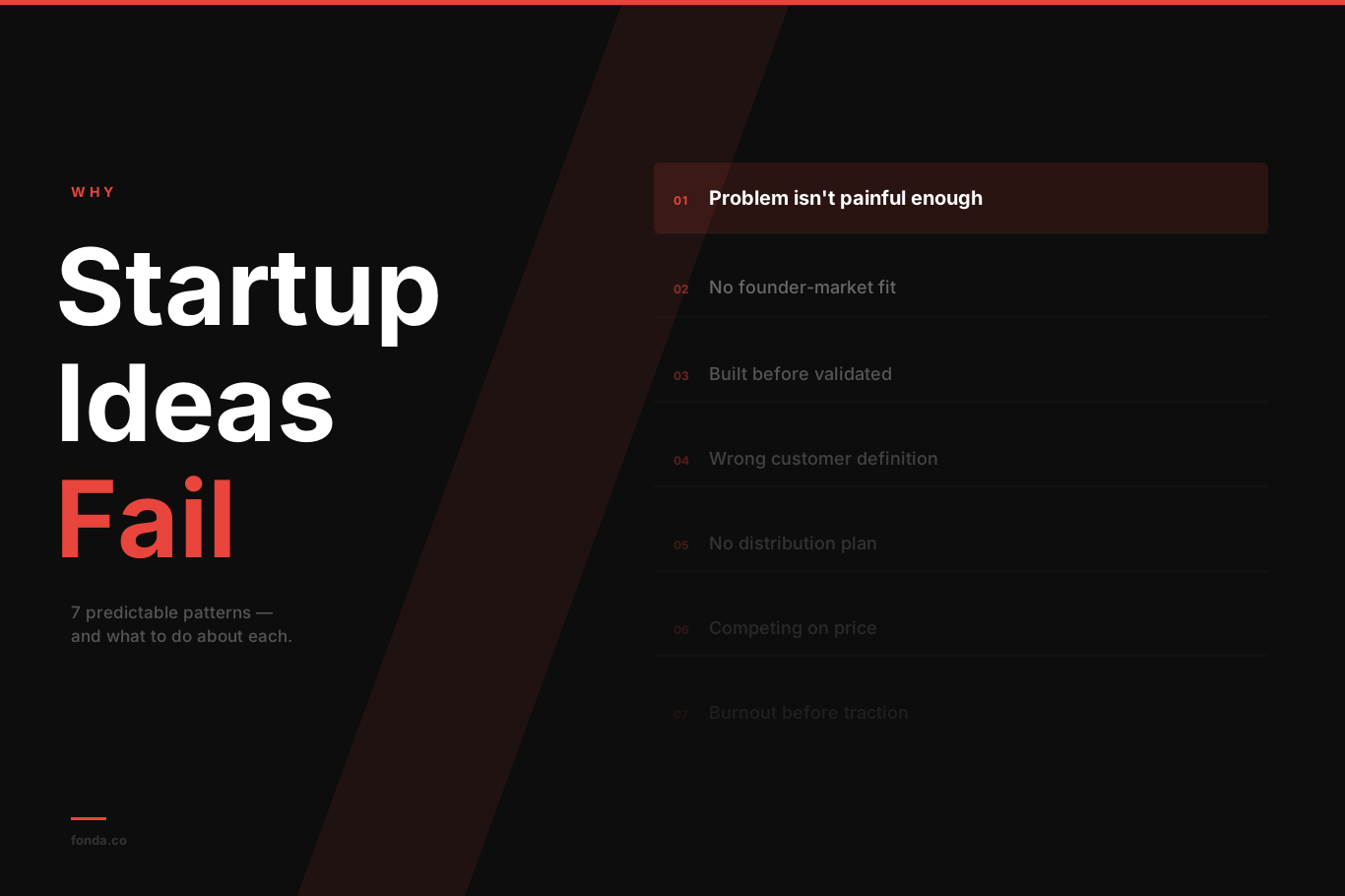
The 7 reasons startup ideas fail before launch:
- 1. Problem isn't painful enough (vitamin, not painkiller)
- 2. No founder-market fit (no advantage in the space)
- 3. Built before validated (months of engineering, zero customers)
- 4. Wrong customer definition (too broad to convert)
- 5. No distribution plan ("word of mouth" is not a plan)
- 6. Competing on price in a crowded market
- 7. Founder burnout before traction
The problem isn't painful enough
A vitamin, not a painkiller. Founders pick problems they find interesting, not problems people desperately need solved. If your target customer doesn't lose sleep over this problem, they won't change their behavior or spend money to fix it. The test: can you name five people who would pay to solve this problem right now, today?
Fix
Ask potential customers: 'What have you tried to solve this?' and 'How much have you spent?' Zero spend means zero urgency.
Roast My Idea
Get a score on Problem Clarity before you go further.
No founder-market fit
The founder has no meaningful advantage in this space. No relevant experience, no relevant network, no insight the competition doesn't have. Starting a healthcare startup with no healthcare background, no healthcare connections, and no insight from lived experience means competing against people who have all three.
Fix
List your five strongest professional advantages. Build in the intersection of those — not in the market that seems biggest.
Idea Generator
Generate ideas matched to your specific background and advantages.
Built before validated
Six months of engineering before a single customer conversation. The most common cause of startup death. The founder was so confident in the idea that they treated validation as an afterthought. The market disagreed.
Fix
Set a validation rule before you write a line of code: 'I will not build until I have X paying customers or letters of intent.' X should be at least 5.
Lean Canvas Generator
Map your riskiest assumptions before you build anything.
Wrong customer definition
'Everyone who has a job' is not a customer. 'People who work from home' is not a customer. 'Independent physiotherapists with two to five staff who run their own billing' is a customer. Vague customer definitions lead to unfocused products, unfocused marketing, and zero conversion.
Fix
Write a customer profile so specific you could find 20 of them on LinkedIn in an hour. If you can't, the definition is still too broad.
Business Plan Generator
Force yourself to write a market and customer analysis before you proceed.
No distribution plan
'If we build it, they will come' kills more startups than bad products. How will your first 100 customers hear about you? If the answer is 'word of mouth, social media, and SEO,' you don't have a distribution plan — you have a hope. Real distribution is: a specific channel, a specific message, and a specific acquisition cost.
Fix
Name the single channel that will get you your first 10 customers. Not the first 1,000 — the first 10.
SWOT Analysis Generator
Identify distribution as a Weakness before launch, while you can still fix it.
Competing on price in a crowded market
Entering a market where incumbents are strong and trying to win by being cheaper. This works if you have structural cost advantages (you don't) or if cheapness is the primary purchase driver (it usually isn't). The right response to a crowded market is a narrower beachhead, not a lower price.
Fix
Pick the segment the market leader is ignoring. Own that segment completely before expanding.
TAM SAM SOM Calculator
Size your actual addressable beachhead, not the full market.
Founder burnout before traction
Starting a business while keeping a day job, without a clear plan for how long to run the experiment and what success looks like by month 3. When results don't materialise on an unclear timeline, motivation collapses. The goal stops being 'first customer' and starts being 'survive the week.'
Fix
Set a 90-day experiment with one clear success metric. Three months, one number. If the number is hit, continue. If not, adjust or pivot — but know the rule before you start.
Elevator Pitch Generator
Clarify your core value proposition before spending 90 days testing the wrong thing.
Avoid every one of these
Fonda checks your idea against all 7 before you build
The 14-step journey flags each failure mode at the right stage — before you spend time or money on the wrong thing.
Frequently asked questions
What is the number one reason startups fail?+
Building before validating. Most startup failures can be traced to a founder who was confident enough in their idea to spend months building before talking to real potential customers. The customers then disagree — and the founder has already spent the time, money, and motivation needed to pivot.
Can a bad startup idea be saved?+
Sometimes. Most 'bad' ideas are not fatally flawed — they are described too broadly, targeted at the wrong customer, or priced incorrectly. The idea 'an app for restaurants' might be too broad, but 'a table management tool for independent pizza restaurants in college towns' might be a real business. Narrow the beachhead before you abandon the space.
How do I know if my startup idea is worth pursuing?+
Run the Roast My Idea test (fonda.co/tools/roast-my-idea) for a quick assessment, then have 10 real conversations with people who match your target customer description. If they describe the problem without prompting, mention spending money working around it, and ask when your solution will be ready — you have something worth building.
What is founder-market fit?+
Founder-market fit means you have a specific advantage in solving this particular problem for this particular customer. That advantage could be: professional experience in the industry, a relevant network of potential customers, a lived experience of the problem, or a technical skill that lowers the cost of building the solution. Without any of these, you are competing on equal footing with everyone else who sees the opportunity.