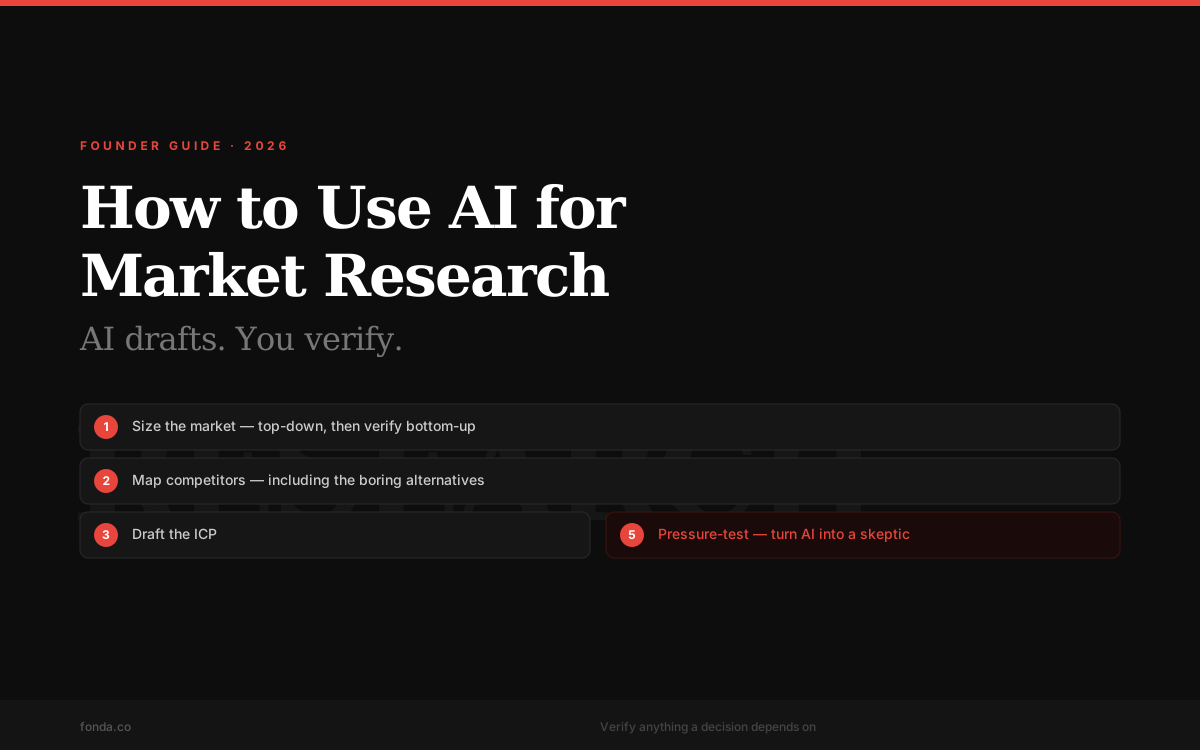
How to Use AI for Market Research
AI can compress weeks of market research into an afternoon — sizing, competitors, customers, demand. The catch: it's confidently wrong just often enough to sink you. Here's how to use it well.
The short version
Use AI to draft fast — market size, competitor map, ICP, demand signals, and a skeptical stress-test — then verify anything a decision depends on against primary sources and real customer conversations. AI gets you to a strong hypothesis; it can't confirm one.
Traditional market research is slow, and most founders skip it or fake it. AI changes the economics: you can get a credible first draft of the whole picture in an afternoon. But AI has one dangerous habit — it states guesses with the same confidence as facts. Used carelessly, that turns into a business plan built on a hallucinated number.
The fix isn't to avoid AI. It's a simple division of labor: AI drafts, you verify. Here's how to run each part of market research that way.
The 5-step AI market research workflow
1. Size the market (top-down, then check it)
Ask AI for a fast top-down estimate: how many potential customers exist and what they'd pay. It's great for a first-pass number and for surfacing the data sources you should check. But treat the figure as a hypothesis, not a fact — then verify it bottom-up with a real count of customers times a real price.
2. Map the competitors
AI is fast at listing direct and indirect competitors, their positioning, and rough pricing tiers. Prompt it to include the 'boring' alternatives too — spreadsheets, agencies, doing nothing — since that's what you're really competing with. Then visit the sites yourself; AI's competitor facts drift out of date and it sometimes invents features.
3. Understand the customer
Use AI to build a first draft of your ideal customer profile (ICP): who they are, what they're trying to get done, where they hang out, and what they've tried before. This is a hypothesis to test, not a conclusion — but it gives your customer interviews a sharp starting point instead of a blank page.
4. Find where demand actually is
Point AI at demand signals: search-interest trends, communities discussing the problem, recent funding in the space, and competitor launches. A rising wave in real signals is worth more than any survey. AI can help you find the threads; you still have to read them.
5. Pressure-test your assumptions
Turn AI into a skeptic. Ask it to argue the opposite: why this market might be too small, too crowded, or not ready. A good 'roast' of your thesis surfaces the assumption most likely to be wrong — which is exactly what you should test first with real customers.
The golden rule: verify what a decision depends on
You don't need to fact-check every sentence AI produces — that would defeat the point. You need to verify the load-bearing facts: the numbers and claims that, if wrong, change your decision. Your market size, your top competitor's pricing, whether demand is actually rising. For those, get to a primary source or a real customer. Everything else, let AI move fast.
A good tell: if a number feels too clean or too flattering, it probably came from thin air. Real market data is messy. Prefer math you can trace — customers times price — over a single impressive figure.
Do it faster with free tools
You can run this whole workflow in a chat window, but a few free tools remove the busywork and keep the math honest:
- TAM SAM SOM Calculator — turn your inputs into investor-ready market-size numbers with the math kept transparent (that's step 1).
- Roast My Idea — the fastest way to run step 5: an honest critique of the assumptions most likely to be wrong.
- Idea Generator — if your research kills the idea, generate fresh, problem-first ones to research next.
For the step AI can never do for you, read how to validate a startup idea — the customer conversations where the real market lives.
Market research, without the guesswork
Fonda pulls real market signals matched to your idea and sizes your market with transparent math — then tells you what to test first. Start free.
Size my market free →Frequently asked questions
Can AI do market research accurately?
AI is excellent for speed and breadth — a first-pass market size, a competitor list, a draft ICP, and directions on where to dig. It is not reliable for precise, current facts: it can present out-of-date numbers or invent details with total confidence. The right workflow is AI-for-drafting, human-for-verifying. Use it to get to a strong hypothesis fast, then confirm the load-bearing numbers with primary sources and real customer conversations.
How do I stop AI from hallucinating market data?
Three habits. First, ask it to cite sources and then actually check them. Second, cross-check any number that a decision depends on against a primary source (census data, industry reports, competitor pricing pages). Third, prefer bottom-up math you can trace — customers × price — over a single top-down figure the AI produced. If you can't verify a number, treat it as an assumption to test, not a fact to build on.
What's the best way to size a market with AI?
Do both directions. Let AI give you a quick top-down TAM to sanity-check the scale, then build a bottom-up estimate you can defend: number of realistic customers times what they'll actually pay, filtered to who you can reach. A free TAM/SAM/SOM calculator turns your inputs into investor-ready numbers in minutes and keeps the math transparent, which matters more than a big impressive figure.
Is AI market research good enough to skip talking to customers?
No — and this is the most important point. AI can prepare you brilliantly for customer research, but it can't replace it. Real demand only shows up when actual people spend time, money, or attention on the problem. Use AI to sharpen your questions and shortlist who to talk to, then go have the conversations. The market lives in those calls, not in a chat window.